Contact Desk
Early Aviation Historic Aircraft Aviation Milestones Aircraft Technology Famous Flights About Us Contact Us

Piston Engines vs Jet Engines How They Power Aircraft Differently

AIRCRAFT ENGINEERING LAB · PROPULSION SYSTEMS Two Different Engines. One Shared Goal: Creating Thrust. Explore how reciprocating piston engines and gas-turbine jet engines convert fuel into useful power—and why different aircraft rely on different propulsion technologies. PISTON POWER JET PROPULSION AVIATION TECHNOLOGY Aircraft engines perform one of aviation’s most important tasks: providing the propulsion needed … Read more

From Short Hops to Ocean Crossings The Milestones That Made Long-Distance Flight Possible

AVIATION MILESTONES · 1903 TO THE JET AGE How Aviation Crossed Continents and Conquered the World’s Oceans Follow the breakthroughs in aircraft engineering, navigation, endurance, and international aviation that transformed brief experimental flights into global transportation. 1903 FIRST POWERED FLIGHT   →   1919 ATLANTIC CROSSINGS   →   1927 SOLO FLIGHT   →   … Read more

The Douglas DC-3 How One Aircraft Transformed Passenger Air Travel

THE GOLDEN AGE OF AVIATION · AIRLINER HISTORY The Airliner That Made Flying a Practical Way to Travel Discover how the Douglas DC-3 combined speed, reliability, passenger comfort, and operating efficiency to reshape commercial aviation. 1935FIRST FLIGHT 2PISTON ENGINES 1936AIRLINE SERVICE In the early 1930s, passenger aviation was still developing into a dependable transportation industry. … Read more

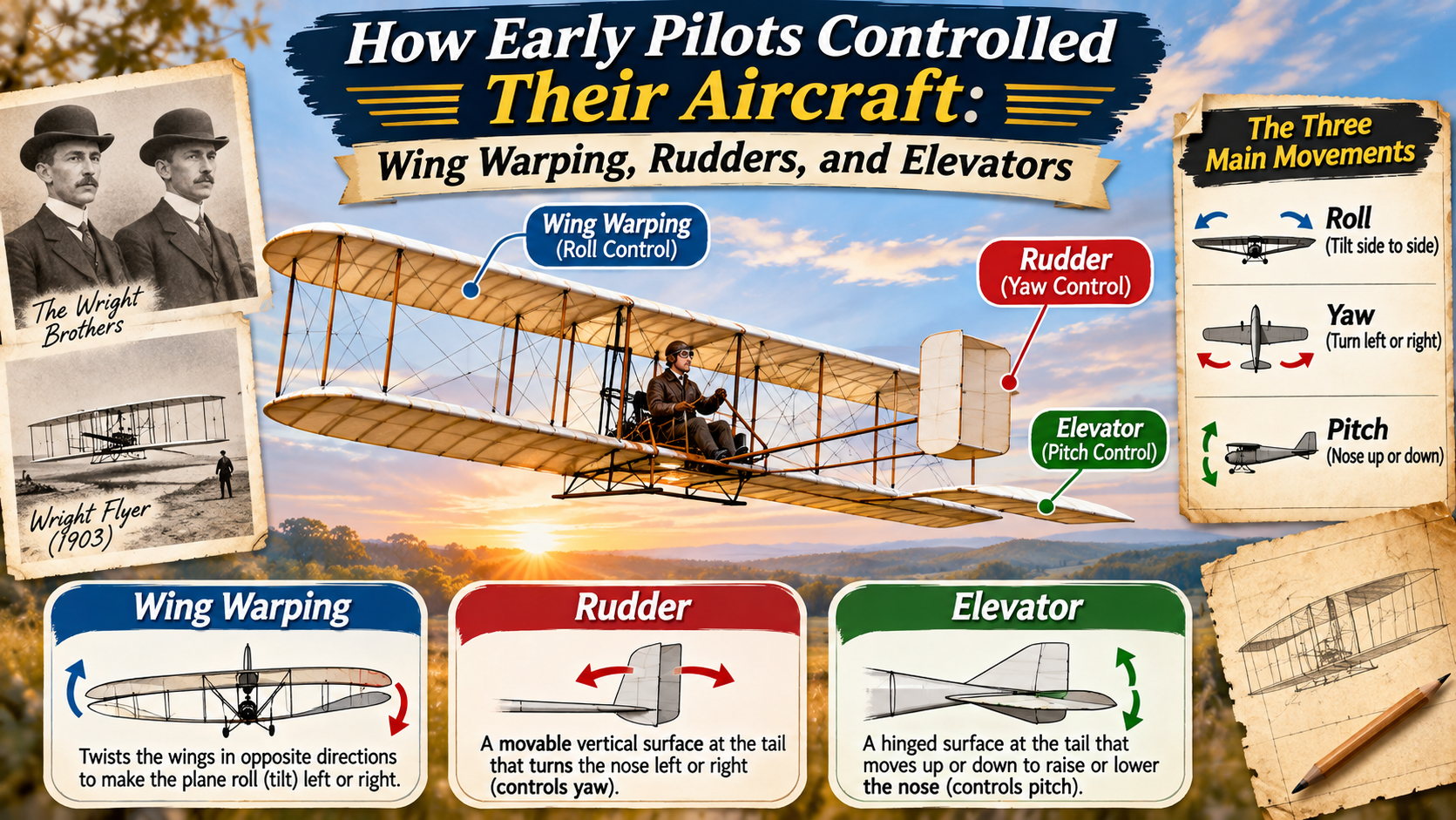
How Early Pilots Controlled Their Aircraft Wing Warping, Rudders, and Elevators

THE AVIATION ENGINEERING JOURNAL · 1903–1915 Before Modern Flight Controls, Pilots Learned to Twist the Wings. Explore how aviation pioneers developed wing warping, rudders, and elevators to control the movement of early powered aircraft. When the first powered airplanes began flying in the early twentieth century, pilots faced a challenge that was just as important … Read more

Wiley Post and the Winnie Mae: Stratospheric Flight and the World’s First Pressure Suit

In the folklore of early aviation, few pioneers combined technical ingenuity, physical resilience, and fearless vision quite like Wiley Hardeman Post. Blind in his left eye from an oilfield drilling accident, the Oklahoma aviator conquered the skies through sheer instinctive mastery and scientific daring. Flying his beloved Lockheed Vega monoplane, the Winnie Mae, Post set … Read more

Howard Hughes and the 1938 Around-the-World Record Flight in a Lockheed 14

In July 1938, billionaire industrialist, filmmaker, and obsessive aeronautical engineer Howard R. Hughes Jr. captivated the international public by completing a breathtaking circumnavigation of the globe. Flying a specially modified Lockheed Super Electra 14-N2 dubbed New York World’s Fair 1939, Hughes and a hand-picked crew of four master flight technicians circled the northern hemisphere in … Read more

Amelia Earhart: Record-Breaking Solo Flights and the Unsolved 1937 Pacific Disappearance

Few figures in aeronautical history capture the world’s imagination quite like Amelia Mary Earhart. Charismatic, determined, and possessing extraordinary piloting courage, Earhart shattered societal gender conventions and set a breathtaking series of world aviation records during the Golden Age of Flight. From becoming the first woman to cross the Atlantic by air in 1928 to … Read more

Charles Lindbergh and the Spirit of St. Louis: The 1927 Solo Transatlantic Triumph

On the rain-soaked morning of May 20, 1927, a slender 25-year-old former airmail pilot named Charles A. Lindbergh strapped himself into the wicker seat of a custom-built monoplane at Roosevelt Field, Long Island. Weighed down by 450 gallons of volatile aviation fuel, the aircraft barely cleared high-tension electrical wires at the runway’s edge before disappearing … Read more

Aerodynamic Evolution: Swept Wings, Delta Wings, and the Transonic Area Rule

As aviation transitioned into the post-World War II jet age, aerodynamicists collided head-on with the brutal physical phenomena of the transonic barrier. Traditional straight-wing aircraft, perfected over decades of low-speed flight, suffered from violent buffet, severe trim changes, control reversal, and an exponential wall of wave drag as airspeeds approached Mach 0.8 to 1.2. Breaking … Read more

Stealth Technology in Military Aviation: From the F-117 Nighthawk to the B-2 Spirit and F-22 Raptor

For decades following the invention of radar in the 1930s, aerial warfare was an escalating contest between ground-based radar emitters and airborne countermeasures. Radar sent pulses of radio frequency energy into the sky, detected the reflections bouncing off metallic aircraft hulls, and guided surface-to-air missiles (SAMs) and interceptors directly to the target. By the Vietnam … Read more