THE AVIATION ENGINEERING JOURNAL · 1903–1915
Before Modern Flight Controls, Pilots Learned to Twist the Wings.
Explore how aviation pioneers developed wing warping, rudders, and elevators to control the movement of early powered aircraft.
When the first powered airplanes began flying in the early twentieth century, pilots faced a challenge that was just as important as producing enough lift to leave the ground: controlling the aircraft once it was airborne.
An airplane must be able to change direction, adjust its nose position, and remain balanced as air moves around its wings and body.
Today, pilots use sophisticated control systems supported by decades of aerodynamic research. Early aviators had none of these advantages.
Instead, aviation pioneers experimented with flexible wings, movable tail surfaces, mechanical cables, and carefully coordinated control movements.
Three developments became especially important: wing warping, rudders, and elevators.
These mechanisms allowed early pilots to influence the aircraft’s movement around its three principal axes.
Understanding how they worked reveals why the earliest successful airplanes were more than engines attached to wings. They were carefully designed machines that could be controlled in flight.
Why Aircraft Control Was Such a Difficult Problem
Before practical powered flight, many inventors focused on generating lift and building lightweight engines.
However, an aircraft that could rise into the air but could not be controlled would remain dangerous and impractical.
Air currents can cause an airplane to roll, pitch, or yaw. A pilot must be able to respond to these movements and intentionally change the aircraft’s attitude.
Early aviation researchers discovered that controlling these motions required more than a single steering device.
The challenge was to develop mechanisms that could influence different movements without making the aircraft excessively heavy or complicated.
THE THREE AXES OF FLIGHT
Roll. Pitch. Yaw.
These three rotational movements describe how an aircraft changes its orientation in the air. Early control systems were designed to influence each movement.
1. Roll: Controlling the Aircraft’s Wings
Roll occurs when an airplane rotates around its longitudinal axis, which runs from the nose toward the tail.
During a roll, one wing rises while the other moves downward.
Controlled rolling is important because airplanes commonly bank when turning.
Early inventors explored different methods of controlling this movement.
One of the most influential solutions was wing warping.
What Was Wing Warping?
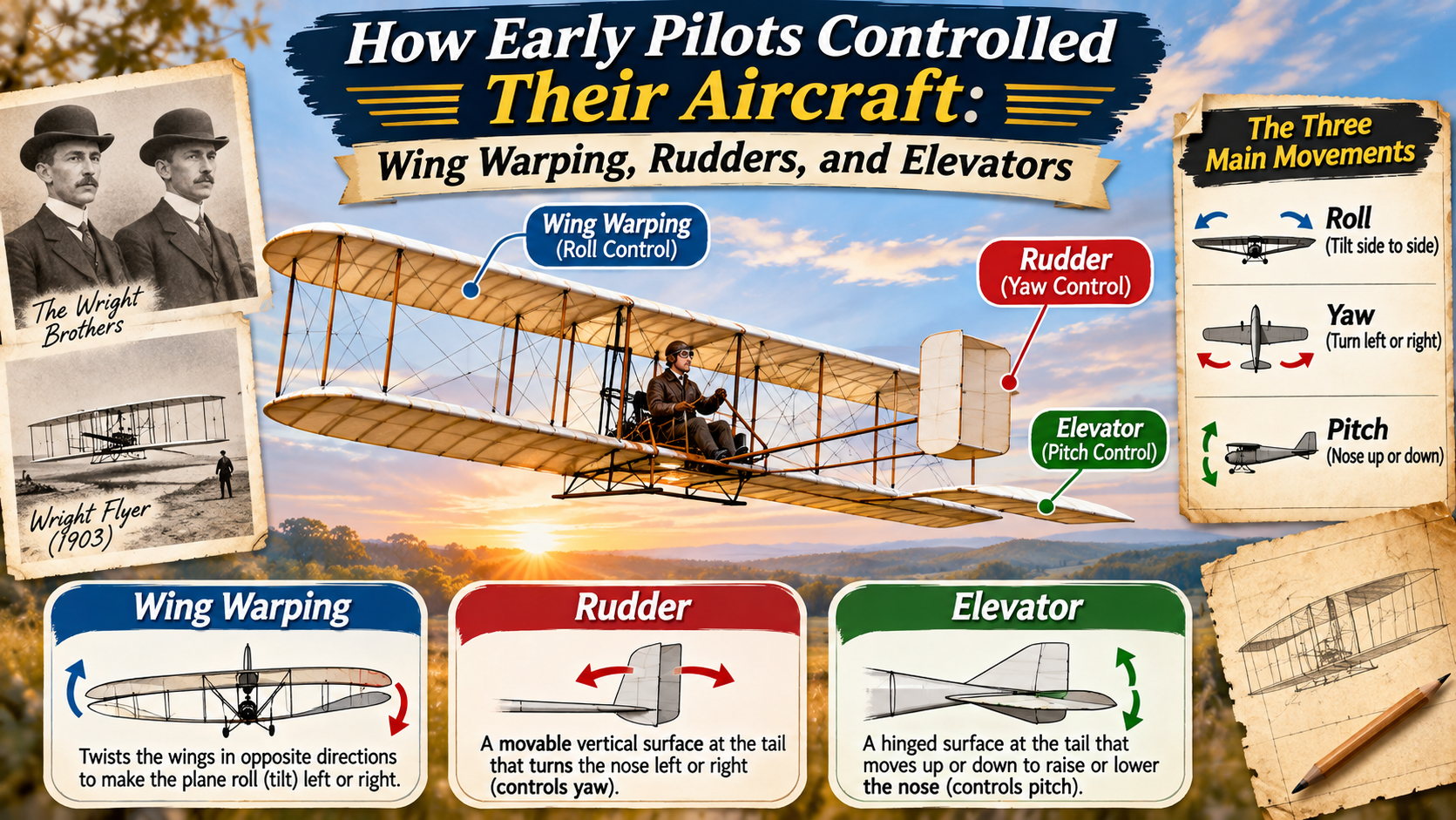
Wing warping was a technique in which the pilot mechanically twisted portions of the wings to change their aerodynamic characteristics.
By changing the angle of the wing surfaces relative to the airflow, the system created differences in lift between the left and right wings.
These differences produced a rolling moment.
Unlike modern airplanes with rigid wings and hinged ailerons, some early aircraft used flexible wing structures that could be distorted through cables and mechanical linkages.
The technique was particularly associated with the Wright brothers.
2. How the Wright Brothers Developed Wing Warping
Wilbur and Orville Wright understood that lateral control was essential for practical flight.
They studied the movement of birds and observed how changes in wing position could influence balance and turning.
The brothers developed wing-warping systems for their early gliders before incorporating the concept into their powered aircraft.
On the 1903 Wright Flyer, the pilot controlled wing warping using a movable hip cradle.
Moving the cradle operated cables that twisted the wings in opposite directions.
This allowed the pilot to influence the aircraft’s roll.
The mechanism was an important part of the Wright brothers’ three-axis control approach.
However, wing warping also created aerodynamic effects that required coordination with the rudder.
Why Wing Warping Was Important
Wing warping demonstrated that a pilot could actively control an airplane’s lateral balance.
It represented a major step beyond designs that depended heavily on passive stability or shifting the pilot’s body weight.
Although wing warping eventually became uncommon in mainstream aircraft design, the principle of controlling roll through differences in aerodynamic force remains fundamental.
3. Rudders: Controlling Yaw
Yaw occurs when an airplane rotates around its vertical axis.
During yaw, the nose turns left or right relative to the aircraft’s original heading.
A rudder is a movable control surface, typically attached to the vertical tail structure.
When deflected, it changes the aerodynamic force acting on the tail and produces a yawing moment.
Rudders were essential components of early aircraft control systems.
However, yawing the airplane does not automatically produce the same type of controlled turn as banking.
Successful turning often requires coordination between roll and yaw controls.
The Problem of Adverse Yaw
When an airplane uses differential lift to roll, differences in aerodynamic drag may cause the nose to yaw in an unwanted direction.
This effect is known as adverse yaw.
The Wright brothers recognized that wing warping could produce unwanted yawing effects.
They linked their wing-warping system with the movable rear rudder so the controls could work together.
This coordination became an important feature of their aircraft.
4. Elevators: Controlling Pitch
Pitch occurs when an airplane rotates around its lateral axis, which extends from one wing toward the other.
Pitch changes the orientation of the aircraft’s nose relative to the horizon.
Elevators are movable aerodynamic surfaces that produce pitching moments.
On many modern airplanes, elevators are located on the horizontal tail.
However, some early aircraft used a forward-mounted elevator arrangement known as a canard.
The 1903 Wright Flyer featured a forward elevator.
This arrangement allowed the pilot to influence the aircraft’s pitch during flight.
Pitch control was especially important during takeoff, landing, and changes in flight attitude.
However, pitch angle and climb rate are not identical. An airplane’s actual flight path depends on airspeed, lift, thrust, drag, and other conditions.
5. How the Three Controls Worked Together
The most important breakthrough was not simply inventing three separate mechanisms.
It was recognizing that controlled flight required coordinated management of roll, pitch, and yaw.
A pilot could use roll control to bank the airplane, rudder control to influence yaw, and elevator control to adjust pitch.
These movements interacted with one another.
For example, changing the aircraft’s bank angle could affect its turning behavior and the amount of lift supporting its weight.
Early pilots had to learn how their particular aircraft responded to combinations of control inputs.
| Aircraft Movement | Axis | Primary Control |
|---|---|---|
| Roll | Longitudinal axis | Wing warping or ailerons |
| Pitch | Lateral axis | Elevator |
| Yaw | Vertical axis | Rudder |
6. Why Wing Warping Was Eventually Replaced
Wing warping worked well enough to demonstrate controlled flight, but it had practical limitations.
The method depended on wings that could twist under mechanical loads.
As aircraft became larger, faster, and more structurally complex, designers increasingly favored control systems that did not require deforming the main wing structure.
Ailerons provided an alternative.
These hinged control surfaces are generally located near the outer portions of the wings.
By deflecting them differently on the left and right wings, pilots can produce rolling moments without twisting the entire wing.
Ailerons became the dominant method of roll control in conventional airplanes.
However, the transition was gradual, and different early aircraft manufacturers experimented with different solutions.
7. The Development of Ailerons
The history of ailerons includes several inventors and competing designs.
Before and during the early years of powered flight, aviation pioneers experimented with movable wing surfaces intended to control lateral balance.
Some designs used hinged panels or auxiliary surfaces.
Others continued to rely on wing warping.
As aviation advanced, ailerons became increasingly practical because they could be incorporated into more rigid wing structures.
They also allowed engineers to refine control effectiveness through changes in surface size, position, and deflection.
Modern aircraft use a variety of roll-control arrangements, sometimes combining ailerons with spoilers or other systems.
8. How Early Pilots Operated Their Controls
Early aircraft did not share one universal cockpit arrangement.
Different designers used different combinations of levers, cradles, control wheels, and foot-operated mechanisms.
The Wright Flyer’s arrangement was particularly unusual by modern standards.
Its pilot lay prone and used body movement to operate the wing-warping controls.
Other aircraft developed more conventional seated positions and hand-operated control systems.
Over time, cockpit controls became more standardized.
Control sticks and wheels became common for pitch and roll, while rudder pedals were widely adopted for yaw control.
This evolution made aircraft handling more familiar across different designs, although important variations remain.
9. The Importance of Mechanical Linkages
Early aircraft relied heavily on direct mechanical connections between the pilot and the control surfaces.
Cables, pulleys, rods, and levers transmitted pilot movements to the wings, rudders, and elevators.
These systems had to be light enough for flight while remaining strong enough to withstand operational loads.
Engineers also needed to account for friction, cable tension, and structural movement.
Mechanical reliability was particularly important because early aircraft had limited redundancy.
Modern airplanes may use advanced hydraulic or electronic control systems, but many still incorporate mechanical components or backup arrangements.
10. What Early Flight Testing Taught Engineers
Early aviation progress depended on repeated testing.
Gliders allowed inventors to study control behavior before attempting sustained powered flight.
Wind-tunnel experiments helped researchers investigate lift, drag, and wing shapes.
Flight tests revealed how aircraft responded to real atmospheric conditions.
These observations exposed weaknesses that theoretical calculations alone could not fully predict.
The Wright brothers’ glider experiments were especially important because they allowed the brothers to refine their understanding of aerodynamic control.
Other aviation pioneers made significant contributions through their own experiments and designs.
Collectively, these efforts helped establish the foundations of practical flight-control engineering.
11. Early Flight Controls Compared With Modern Systems
Modern aircraft still depend on the same basic principles of roll, pitch, and yaw.
What has changed is the technology used to produce and manage those movements.
Early pilots often relied on direct mechanical connections and relatively simple aerodynamic surfaces.
Modern aircraft may use hydraulic assistance, electronic flight-control computers, stability augmentation, and sophisticated sensors.
Fly-by-wire systems can interpret pilot inputs and command control surfaces electronically.
However, the underlying aerodynamic objective remains familiar: controlling the aircraft’s orientation and flight path.
The development from wing warping to advanced flight-control systems illustrates more than a century of engineering progress.
Frequently Asked Questions
What was wing warping?
Wing warping was an early aircraft-control technique that twisted portions of the wings to create differences in aerodynamic lift and produce roll.
Did the Wright Flyer use ailerons?
No. The 1903 Wright Flyer used wing warping for roll control rather than conventional hinged ailerons.
What does a rudder control?
A rudder primarily controls yaw, the rotation of an airplane around its vertical axis.
What does an elevator control?
An elevator primarily controls pitch, which changes the aircraft’s nose-up or nose-down attitude.
Why did early aircraft use wing warping?
Wing warping provided a practical method of roll control using flexible wing structures and mechanical cables.
Why were ailerons adopted?
Ailerons allowed designers to control roll using hinged surfaces, making them suitable for increasingly rigid and advanced wing structures.
Are modern aircraft controlled using the same three axes?
Yes. Roll, pitch, and yaw remain fundamental concepts in aircraft control, even though modern systems use more advanced technology.
Final Thoughts
The earliest powered aircraft succeeded not simply because their engines could produce thrust or their wings could generate lift.
They succeeded because inventors developed practical ways to control movement in the air.
Wing warping allowed pilots to influence roll by twisting flexible wings.
Rudders provided control over yaw, while elevators helped manage pitch.
Working together, these mechanisms formed the basis of three-axis aircraft control.
As aircraft design evolved, ailerons replaced wing warping in most conventional airplanes, and control systems became increasingly sophisticated.
Yet the principles established during the pioneering years remain central to aviation.
Understanding these early mechanisms reveals how experimentation, observation, and engineering transformed powered flight from an uncertain possibility into a practical technology.
AVIATION HISTORY · KEY TAKEAWAY
Wing Warping Controlled Roll. Rudders Controlled Yaw. Elevators Controlled Pitch.
The breakthrough that made practical powered flight possible was the ability to control an aircraft around all three axes.